

 English
  Spanish
  Portuguese
  French
  Russian
1. The Critical Role of VCBs in 10kV-35kV Networks
Modern medium-voltage distribution systems demand switching devices that endure frequent operations without performance loss. The vacuum circuit breaker working principle meets this need directly: each vacuum interrupter (VI) is engineered for tens of thousands of operating cycles with virtually zero maintenance, making it ideal for busy substations and industrial feeders where downtime is costly.
This reliability is why VCB technology has become the undisputed standard across 10kV-35kV MV switchgear components. Compared to oil or air breakers, vacuum interrupters offer faster interruption, no flammable medium, and consistent VCB arc quenching performance cycle after cycle.
For manufacturers building medium-voltage circuit breakers, understanding this foundation is the first step toward correct panel design and long-term field reliability-covered next in the VI mechanism breakdown.
2. Anatomy of a VCB: Core Components Breakdown
The Vacuum Interrupter (VI): The Heart of the System
The vacuum interrupter (VI) mechanism relies on three critical parts: Cu Cr (copper-chromium) alloy contacts that resist welding and erosion, hydro-formed stainless steel bellows that allow smooth contact travel while preserving the seal, and a high-alumina ceramic envelope that maintains internal vacuum integrity for the VI’s full service life.
Operating Mechanisms: Spring vs. Magnetic Actuators
Spring-charged mechanisms offer proven, field-serviceable operation and simpler panel integration. Magnetic actuators use fewer moving parts, reducing mechanical wear and improving long-term reliability-a key consideration when assembling 10kV-35kV MV switchgear components for high-cycle applications.
3. The VCB Working Principle: How Arc Quenching Actually Happens
Phase 1: Contact Separation and Metal Vapor Generation
The vacuum circuit breaker working principle begins the instant contacts separate. At this microscopic gap, intense current density vaporizes a thin layer of the CuCr contact surface, forming a conductive metal-vapor plasma arc that briefly sustains current flow across the gap.
Phase 2: The Zero-Crossing Point (Current Zero)
As the alternating current naturally passes through zero, arc energy dissipates almost instantly. With no vacuum medium to sustain ionization, the metal vapor plasma condenses rapidly back onto the contact surfaces, halting current flow — the defining mechanism behind effective VCB arc quenching.
Phase 3: Rapid Dielectric Strength Recovery
Within microseconds, the high-vacuum gap regains full dielectric strength, allowing it to withstand the Transient Recovery Voltage (TRV) without re-striking. This rapid recovery is central to the reliability of modern medium-voltage circuit breakers.
4. Why VCBs Dominate Over SF6 and Oil in Medium Voltage
Vacuum technology eliminates the need for SF6 gas, a potent greenhouse gas facing tightening global restrictions, making VCBs the clear choice for manufacturers prioritizing environmental compliance.
Beyond emissions, vacuum interrupters enable more compact designs. This directly supports the industry shift toward miniaturized panels, including compatibility with layouts like KYN28 switchgear, where space savings are a major procurement driver.
Mechanically, VCBs also outperform legacy mediums: sealed vacuum interrupters avoid the oil degradation and gas-pressure maintenance that limit SF6 and oil breakers, delivering longer electrical lifespan and fewer service interruptions across 10kV-35kV MV switchgear components.
5. Deployment Scenarios: Indoor Panels vs. Outdoor Networks
Indoor Metal-Clad Switchgear Integration
Inside metal-clad panels, VCB assembly must account for confined airflow and heat buildup from repeated switching. Compact vacuum interrupters simplify thermal management in industrial substations and distribution rooms, supporting dense 10kV-35kV MV switchgear components layouts without compromising cooling.
Outdoor Pole-Mounted Solutions
Outdoor vacuum circuit breakers face different demands: sealed ceramic envelopes and weatherproof housings maintain integrity against moisture, temperature swings, and contamination. This sealing preserves consistent VCB arc quenching performance and fast fault clearing even in harsh, unmanned pole-mounted installations.
6. Technical FAQs for Switchgear Assemblers and Buyers
Q1: What is the significance of the contact material (e.g., CuCr) in a vacuum interrupter?
CuCr alloy resists welding and arc erosion across thousands of operations, directly supporting the vacuum interrupter (VI) mechanism’s long service life and consistent interruption performance.
Q2: How do you address the “current chopping” phenomenon in MV systems?
Current chopping is minimized through optimized CuCr contact composition and low-chopping-current design, reducing transient overvoltage risk in medium-voltage circuit breakers.
Q3: What are the insulation clearance requirements for integrating a 35kV VCB?
Clearance requirements follow applicable standards (e.g., IEC 62271) and depend on panel type, but generally scale with voltage class to ensure safe 10kV-35kV MV switchgear components integration.
7. High-Performance VCB Components for Global Manufacturers
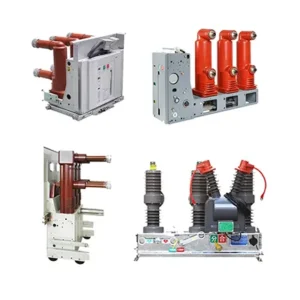
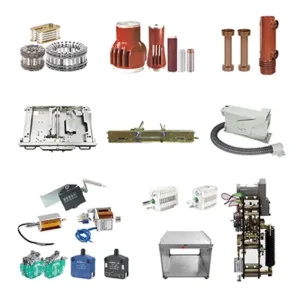
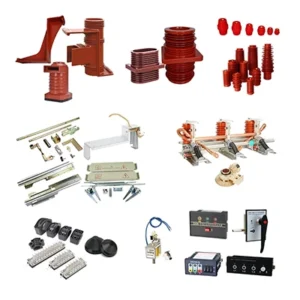
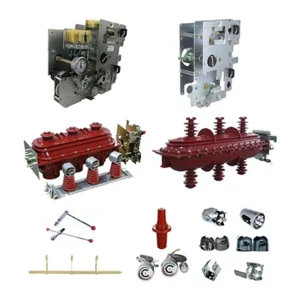
Supplies high-standard 10kV-35kV switchgear parts, including vacuum interrupters, operating mechanisms, and complete indoor/outdoor VCB units built for demanding MV applications worldwide.
For technical specifications, product catalogs, or procurement inquiries, contact our team directly.

